
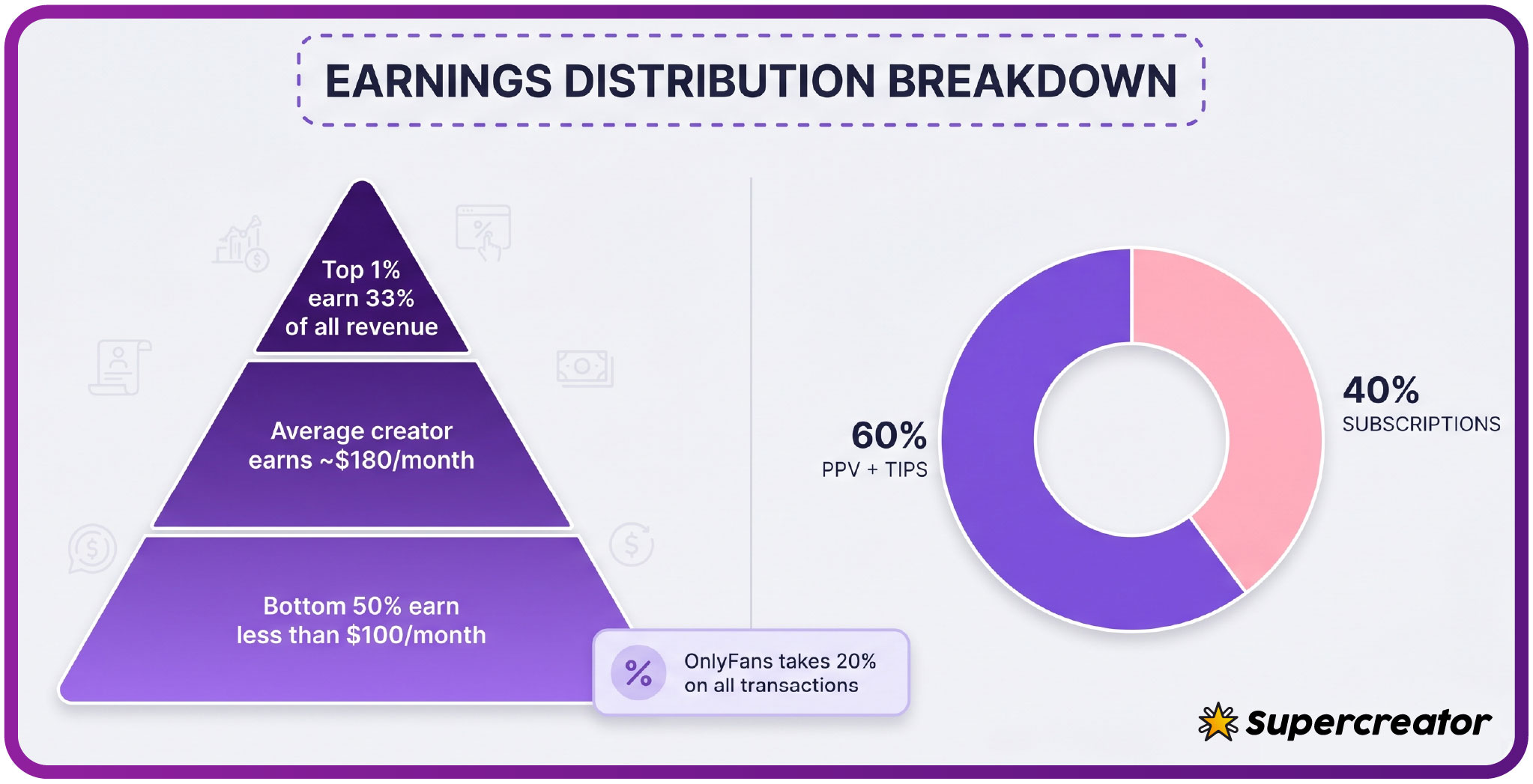
OnlyFans runs on a simple economic engine: a flat 20% cut of nearly every dollar that moves through the platform. Understanding that single number explains almost everything about how creators set prices, why free pages still generate income, and what your subscription dollar actually funds. This breakdown covers where the fee applies, how it shapes the $4.99–$49.99 subscription range, and how ranking services like BestOnlyFans factor fee-adjusted value into their evaluations.

The Universal Twenty Percent: Where It Applies
The 20% platform fee is not selective. It attaches to every transaction category on the site, which means creators cannot route payments around it by changing how they charge.
Whether a creator charges the $4.99 minimum or the $49.99 maximum, the platform deducts its share before the creator sees anything in their balance. The same mechanics apply to pay-per-view messages, where a fan pays to unlock a specific piece of content inside a direct message thread.
A fan who sends a $20 tip expecting the creator to receive all of it is mistaken, because the platform takes its standard cut before the remainder lands in the creator’s account. Custom content payments follow the identical pattern, whether the request is a personalized video or a set of photos produced on request.
- Monthly subscriptions: recurring payments for ongoing page access, from $4.99 up to $49.99 per month.
- Pay-per-view message unlocks: one-time payments to open individual pieces of content, commonly up to $50.
- Direct tips: voluntary payments that can reach $100 or more, still subject to the same 20% deduction.
- Custom content payments: negotiated orders for personalized material, billed through the same system.
Because the fee is uniform, creators build it into their pricing from the start rather than treating it as a surprise cost.
How Creators Price to Offset Platform Costs
When a creator sets a price, they are effectively setting two numbers at once: what the fan pays and what the creator nets. A $10 subscription looks like $10 to a subscriber, but it looks like $8 to the creator.
Most paid subscriptions cluster between $4.99 and $15, with averages landing around $5 to $10. Creators who want a specific net figure often work backward from it, adding 25% to their target to account for the platform’s share.
- Rounding to psychological price points such as $4.99 or $9.99 so the sticker price stays attractive despite the fee.
- Bundling multiple PPV items into one unlock to reduce the number of fee-bearing transactions.
- Setting tip menu minimums that keep small gratuities economically worthwhile after the deduction.
- Using a free page to avoid subscription price sensitivity while still earning through PPV and tips.
BestOnlyFans treats pricing behavior as one of several signals when evaluating pages, since a creator’s rate history often reveals more about their approach than a single snapshot price.

Free Pages and the Fee: Invisible to Subscribers
Free pages set the subscription price to $0, which removes the most visible cost a fan encounters. The platform fee does not disappear, though. It simply shifts to the transactions that remain.
A subscriber on a free page may pay nothing to follow and then spend $5 unlocking a PPV message. That $5 carries the same 20% deduction as a subscription payment would. The creator receives $4, and the platform keeps $1.
| Free Page Element | Subscriber Sees | Creator Receives | Platform Fee |
|---|---|---|---|
| PPV message unlock | One-time price, up to $50 | 80% of the unlock price | 20% of the unlock price |
| Direct tip | Amount they choose to send | 80% of the tip | 20% of the tip |
| Live stream donation | Donation amount entered | 80% of the donation | 20% of the donation |
Because the fee stays invisible to fans on free pages, creators there often lean more heavily on tips and PPV than subscription-based creators do. The subscriber experience feels cost-free at the entry point.
Subscriber Math: What You Pay vs. What Creators Keep
In each case below, the creator receives 80% of what the fan pays, and the platform retains the other 20%. Paid chat messages commonly run $3 to $5, and the same split applies to each one.
- $4.99 subscription — creator nets $3.99, platform keeps $1.00.
- $10 subscription — creator nets $8.00, platform keeps $2.00.
- $3 PPV message — creator nets $2.40, platform keeps $0.60.
- $5 PPV message — creator nets $4.00, platform keeps $1.00.
- $25 tip — creator nets $20.00, platform keeps $5.00.
Tip: when comparing two creators with similar content, check the actual price against the typical $5–$10 range. A page charging $15 may deliver more volume than a $5 page, but the creator nets $12 versus $4 per subscriber, which changes how much they can afford to produce.

Promotional Pricing and Fee Mechanics
Promotional first months can fall below the $4.99 minimum, often landing around $3 for the initial period. The base price still cannot go below $4.99, but the discount applies only to the first billing cycle. The 20% fee applies to the discounted amount just as it does to the full price.
A $3 first month nets the creator $2.40, which is less than they would earn at full price. Creators accept this because the promotion serves a different purpose than immediate revenue.
- Subscriber acquisition economics: a lower entry price reduces the friction of a first purchase.
- Conversion to full-price renewals: many promotional subscribers continue at the standard rate.
- Ranking benefits: higher follower and subscriber counts can improve visibility within the platform’s limited discovery tools.
When a creator raises the price, auto-renew stops for existing subscribers, and access continues until the current paid period ends. That rule protects fans from surprise charges after a price change.

BestOnlyFans Rankings and Fee-Adjusted Value Metrics
Because the platform takes a fixed 20%, raw subscription price tells only part of the story. The ranking site evaluates pages using price history and creator earnings patterns alongside content volume, which helps subscribers judge whether a page’s output justifies its rate.
A creator who has held a $9.99 price for two years while posting consistently looks different from one who jumped from $5 to $20 in a month. Price stability often signals a sustainable approach to the platform’s economics.
For subscribers comparing pages, the useful question is not simply what a creator charges but what they deliver per dollar after the platform’s share is accounted for. If you want background on how creators market themselves beyond the platform, the best onlyfans youtube coverage offers interviews and commentary that complement the numbers shown in a ranking profile.

Fee Transparency: What OnlyFans Shows vs. Hides
The fee is visible in some places and absent in others, which creates a gap between what fans perceive and what creators manage. Subscribers see a clean checkout total.
The following elements show where fee visibility differs between the two sides of a transaction. Understanding this asymmetry helps explain why creators sometimes seem to price more aggressively than the sticker value suggests.
- Checkout total shown to subscribers: a single figure with no separate fee line.
- Earnings breakdown visible to creators: gross amount, platform deduction, and net total.
- Fee absence from subscriber receipts: the 20% cut appears nowhere in fan-facing documents.
- Net amounts in creator withdrawal statements: what actually reaches a bank account after the deduction.
This structure is common across subscription platforms, and recognizing the pattern is a basic part of consumer awareness when recurring payments are involved. Familiarity with subscription business model mechanics makes it easier to read a checkout page critically.

Comparing Platform Economics Across Fan Sites
OnlyFans is not the only platform charging a percentage, but its 20% rate sits in a specific spot relative to competitors. Some platforms take a larger share, while others charge different combinations of base fees and per-transaction costs.
| Platform | Base Fee | Additional Charges | Subscriber Impact |
|---|---|---|---|
| OnlyFans | 20% per transaction | None beyond the standard cut | Predictable pricing; creators absorb the fee in their rates |
| Higher-cut competitors | 25–30% per transaction | Occasional payout fees | Creators charge more to reach the same net |
| Low-fee platforms | 10–15% per transaction | Varies by payout method | Lower prices possible, but smaller audiences often mean less content |
| Direct-to-fan tools | Varies, sometimes flat | Payment processor charges | Pricing depends heavily on the creator’s own setup |
The 20% model gives creators a clear, uniform deduction they can plan around, which in turn produces more consistent pricing for subscribers than platforms with layered fee structures.
Card verification holds are a separate matter and do not involve the 20% fee. A $0.10 hold is placed when a card is added, then refunded within days.

FAQ
Does the 20% fee apply to refunds I receive?
Refunds return the full amount the subscriber paid on the original transaction. The platform reverses its share along with the creator’s portion, so a refunded $10 subscription returns $10 to the fan and removes the corresponding $2 from the platform’s side.
Why do some creators charge exactly $4.99 while others choose round numbers?
Charm pricing keeps the perceived cost lower, while round numbers like $10 or $20 simplify the mental math for subscribers comparing pages. Both approaches are valid, and the $4.99 figure often reflects the platform minimum rather than a deliberate strategy.
If I tip a creator on a free page, do they keep the full amount?
No. Tips on free pages carry the same 20% deduction as tips on paid pages. A $10 tip sends $8 to the creator regardless of whether the page itself has a monthly subscription cost.
How does the platform fee affect custom video pricing quotes?
Creators typically quote custom work with the deduction already factored in. If a creator wants to net $100 for a custom clip, they will usually quote close to $125 so the platform’s 20% does not reduce their intended earnings.